

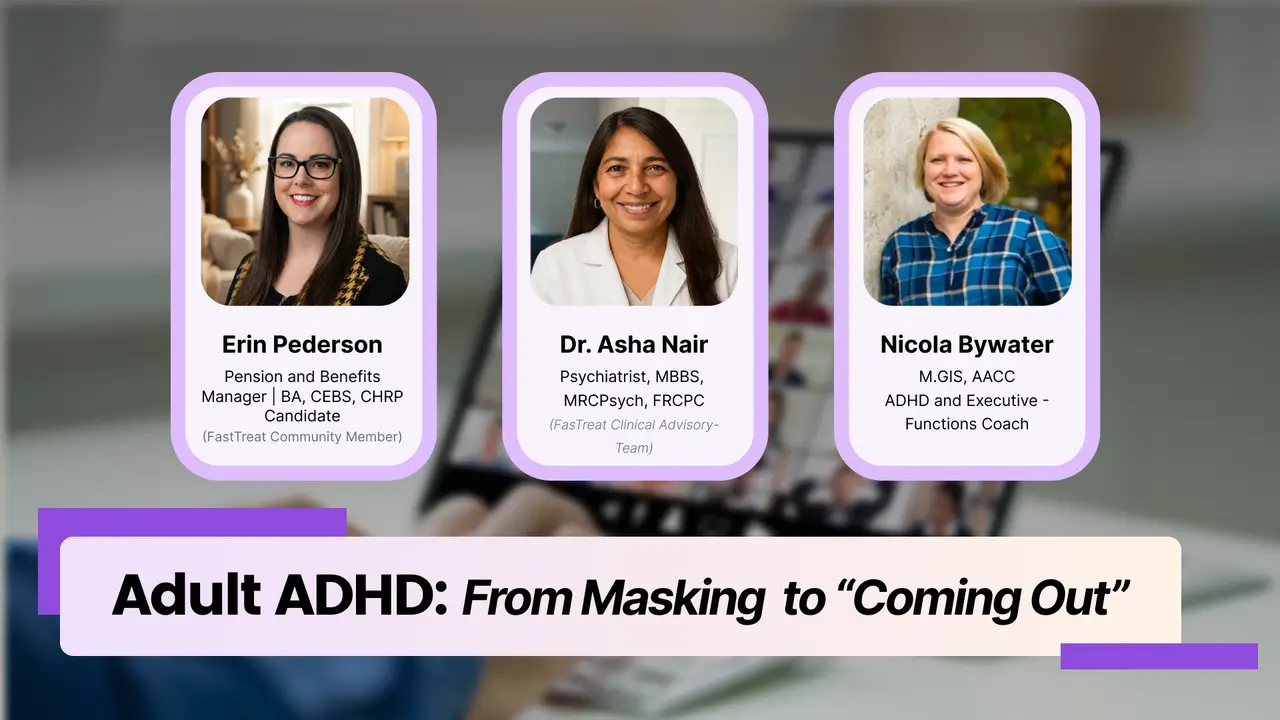
On March 21 at 8:00 PM EDT, FasTreat hosted a live online educational event titled “Adult ADHD: From Masking to ‘Coming Out’.” The session brought together clinical expertise, ADHD coaching insights, and lived experience to explore how ADHD presents in adulthood.
The event focused on adult ADHD masking, late-life diagnosis, executive functioning challenges, the importance of treatment and ongoing support, and practical self-advocacy strategies for daily life.
The session was moderated by Erin Pederson (FasTreat Community Member, Pension and Benefits Manager) and featured:
Dr. Asha Nair, MBBS, MRCPsych, FRCPC (FasTreat Psychiatrist)
Nicola Bywater, M.GIS, AACC (ADHD & Executive Functions Coach)
Masking and the Hidden Experience of Adult ADHD
A central theme of the webinar was masking, where individuals consciously or unconsciously suppress ADHD-related traits to function in daily life, often at significant emotional and cognitive cost.
Erin Pederson shared her experience as a late-diagnosed adult:
“I never for a minute thought that I had ADHD. The realization came to me slowly over time. I like to sit on my couch at the end of the night with my cat on my lap and watch reels to unwind from my day.”
Dr. Asha Nair explained that masking can significantly delay diagnosis, particularly in individuals who appear outwardly high-functioning:
“ADHD is not a disorder of capacity. It is a disorder of inconsistency.”
She noted that many individuals develop strong compensatory mechanisms that can conceal underlying executive functioning challenges for years, often leading to burnout before diagnosis and support.
From Awareness to Action: Strategies and the Role of Treatment
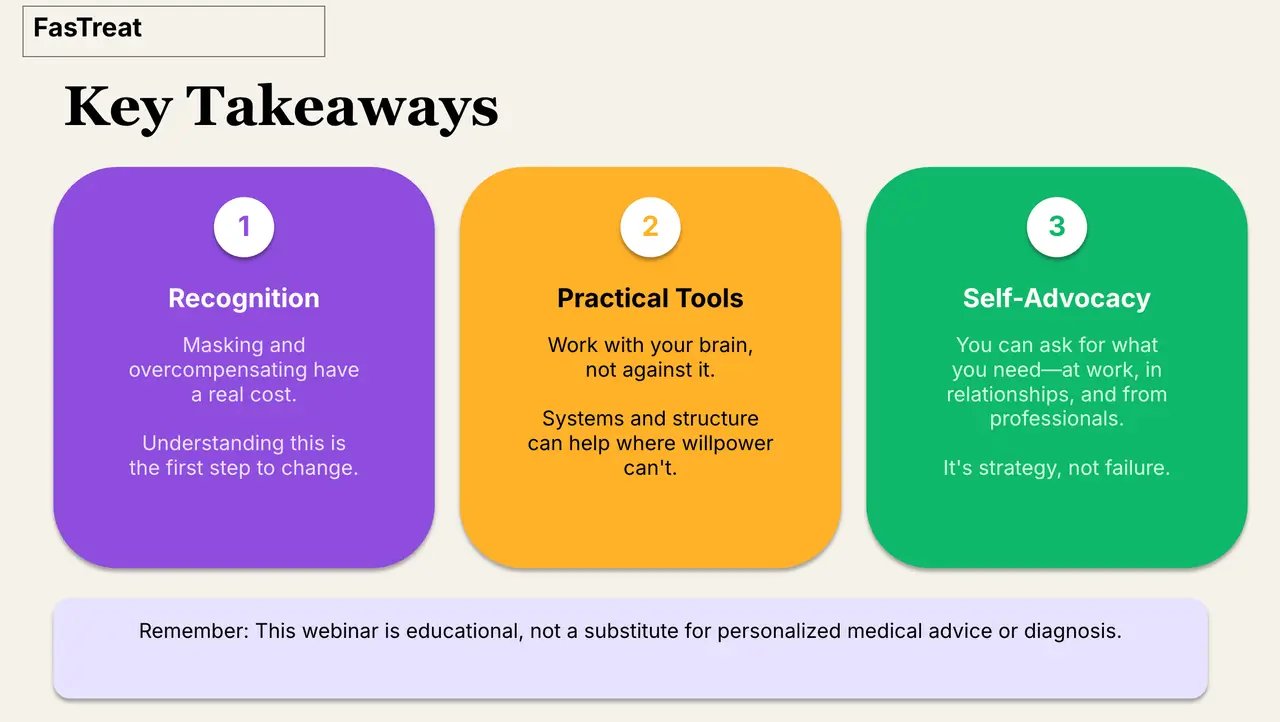
The panel also discussed practical strategies to support executive functioning challenges in daily life, alongside the importance of appropriate clinical evaluation and treatment when needed, as part of a holistic approach to ADHD care.
Nicola Bywater emphasized that difficulties such as procrastination and task initiation are neurological rather than behavioral in nature:
“I want to do it. I just can’t start, and we’re stuck.”
Key strategies discussed included:
Early signs and developmental patterns of ADHD
The relationship between ADHD, stress, and trauma responses
Genetic and neurological factors contributing to ADHD
Variability of symptoms across different life stages
Emotional regulation and impulsivity
Access to diagnosis, treatment, and ongoing support
Erin Pederson highlighted the impact of small, structured changes:
“The two-minute rule was life changing for me, not because it made the task shorter, but because it made starting it survivable.”
Dr. Asha Nair emphasized that while awareness and strategies are important, clinical support and treatment can play a significant role for many individuals as part of a broader care plan:
“For many individuals, understanding ADHD is only the first step. Ongoing support — which may include clinical treatment, coaching, and lifestyle adjustments — can make a meaningful difference in long-term outcomes.”
Self-Advocacy: Empowering the Individual
The final segment addressed self-advocacy in the workplace and interpersonal relationships. The experts agreed that self-advocacy begins with internal self-compassion.
Dr. Asha Nair reminded participants that disclosure is a personal choice:
“It’s not that you owe everyone an exact explanation of everything that is happening with you. Frame your needs around your goals.”
Erin Pederson provided practical workplace scripts:
“You don’t need to provide a medical context. Try saying: ‘I do my best work when things are communicated in writing’ or ‘I need to take notes to stay engaged.’”
Nicola Bywater added a final note on the necessity of kindness:
“You’re not gonna get very far if you’re being really critical of yourself. Advocacy starts with being on your own team.”
Key Topics Discussed
The webinar addressed key questions and themes surrounding adult ADHD, including:
Early signs and developmental patterns of ADHD
The relationship between ADHD, stress, and trauma responses
Genetic and neurological factors contributing to ADHD
Variability of symptoms across different life stages
Emotional regulation and impulsivity
Access to diagnosis, treatment, and ongoing support
Closing Reflections
The event concluded with a shared emphasis on self-awareness, compassion, stigma reduction, and the importance of accessible diagnosis and treatment support.
Dr. Asha Nair:
“You’re still you, but you’re now able to appreciate yourself in a different way.”
Nicola Bywater:
“Honoring your limits is a strength, not a weakness.”
Erin Pederson:
“If anything shared today resonates with you, I hope you feel a little less alone.”
About FasTreat
FasTreat is a technology-driven virtual care platform focused on providing accessible, efficient, and affordable treatment for adults with ADHD. The platform brings together experienced ADHD specialists across Canada and is committed to advancing the availability of mental health services through innovation. Headquartered in Ontario, FasTreat currently offers services in key provinces, including Ontario, Alberta, and British Columbia.